University of OxfordAI Competency Centre
How to Teach and Learn with ChatGPT: AI and new horizons for assistive technologiesSlide reader
Contents (16 slides)
  1. How to Teach and Learn with ChatGPT: AI and new horizons for assistive technologies
  2. Lots of developments since we scheduled the session

  3. What has changed
  4. bit.ly/academic-ai-newsletter
  5. Poll: What is your experience with ChatGPT?
  6. Poll: Experience?
  7. Comparison from a recent talk
  8. Poll: What do you think AI might be best at?
  9. What do you think AI might be best at?
  10. Comparison with a recent talk
  11. What it is actually good at?
  12. Nobody expected AI to be any good at this
  13. Or this
  14. We thought AI could do this
  15. But it is also unexpectedly good at this
  16. How do we know what modern AI will be good or bad at?

How to Teach and Learn with ChatGPT: AI and new horizons for assistive technologies

Dominik Lukes, EduTools.fyi

View original slide 1

Lots of developments since we scheduled the session

A rocket icon beside the slide’s statement.

View original slide 2

What has changed

  • Bing Chat
  • GPT-4
  • Google Bard
  • Office ‘Co-Pilot’s
  • GPT-4 Plugins

View original slide 3

bit.ly/academic-ai-newsletter

https://bit.ly/academic-ai-newsletter
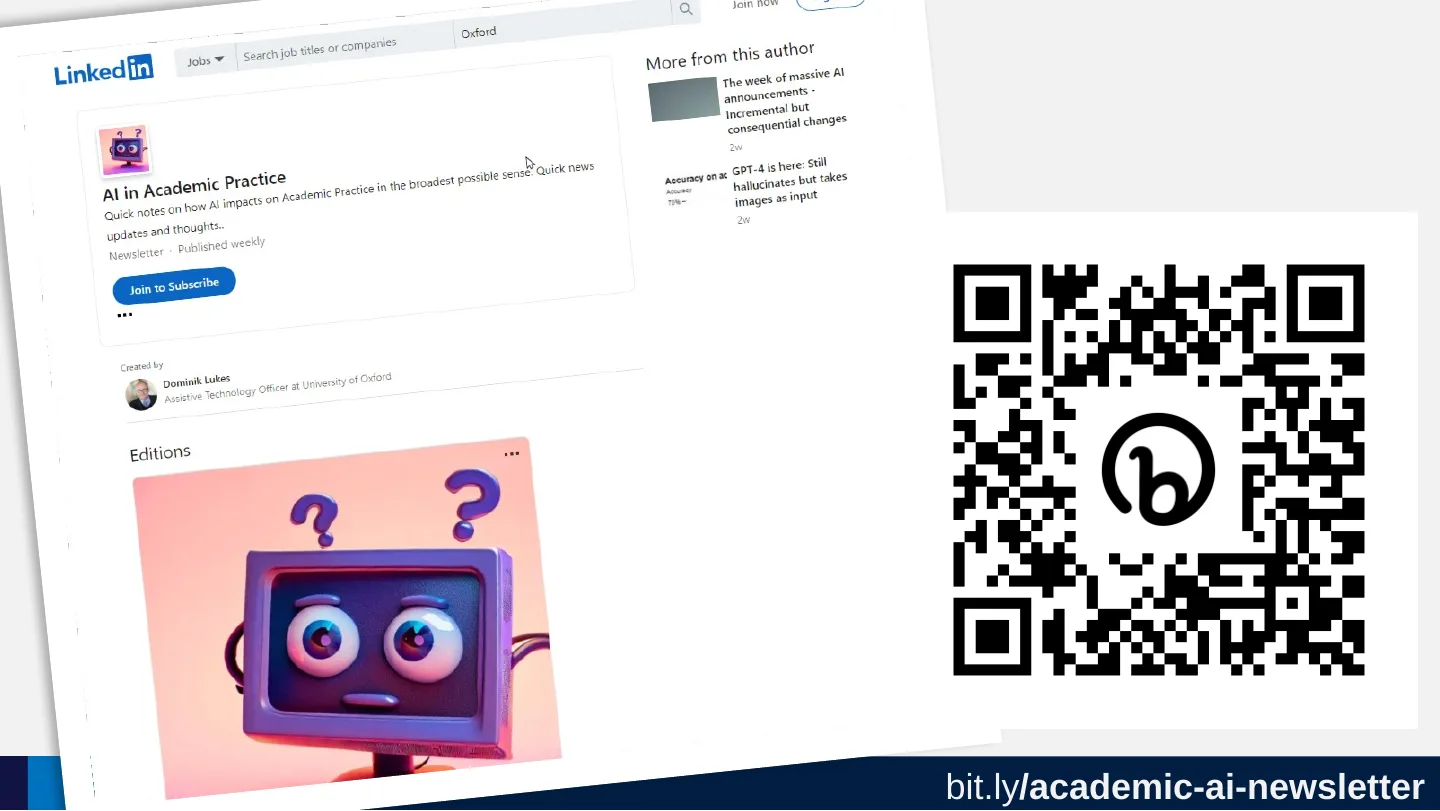
Screenshot of the LinkedIn newsletter “AI in Academic Practice” with a cartoon computer with a puzzled face and question marks, beside a QR code.

View original slide 4

Poll: What is your experience with ChatGPT?

A raised-hand icon beside the poll question.

View original slide 5

Poll: Experience?

  • Use it every day
  • Played around with it
  • Heard a LOT about it
  • I heard something about it

View original slide 6

Comparison from a recent talk

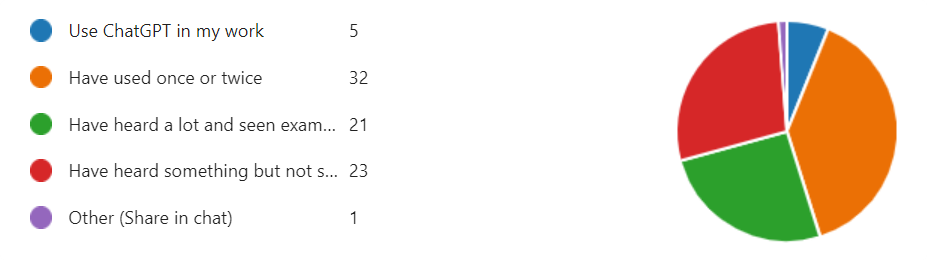
A poll result from an earlier talk: a pie chart beside the answers Use ChatGPT in my work (5), Have used once or twice (32), Have heard a lot and seen examples (21), Have heard something but not sure (23) and Other (share in chat) (1).

View original slide 7

Poll: What do you think AI might be best at?

A raised-hand icon beside the poll question.

View original slide 8

What do you think AI might be best at?

  • Looking up facts
  • Performing complex calculations
  • Writing computer code based on text
  • Making complex decisions from data
  • Writing poetry
  • Making beautiful art

View original slide 9

Comparison with a recent talk

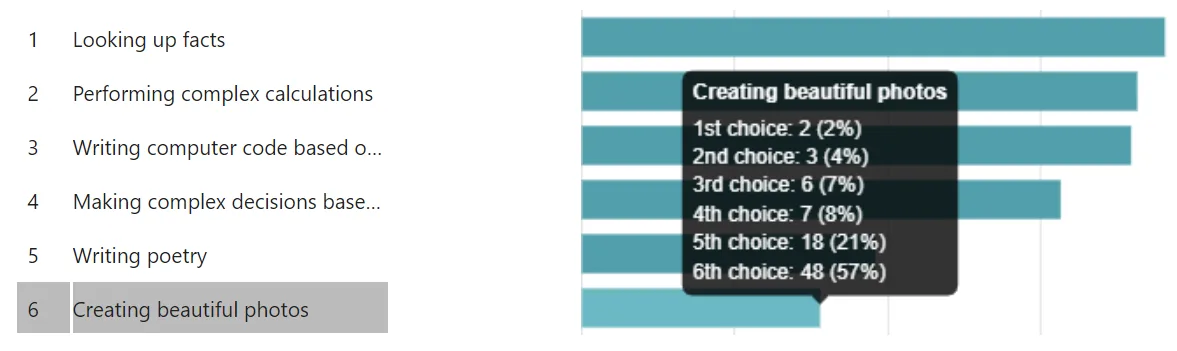
A horizontal bar chart of poll results for what AI might be best at, listing Looking up facts, Performing complex calculations, Writing computer code based on text, Making complex decisions based on data, Writing poetry and Creating beautiful photos, with a pop-up for “Creating beautiful photos”: 1st choice 2 (2%), 2nd choice 3 (4%), 3rd choice 6 (7%), 4th choice 7 (8%), 5th choice 18 (21%), 6th choice 48 (57%).

View original slide 10

What it is actually good at?

A superhero-flying icon beside the question.

View original slide 11

Nobody expected AI to be any good at this
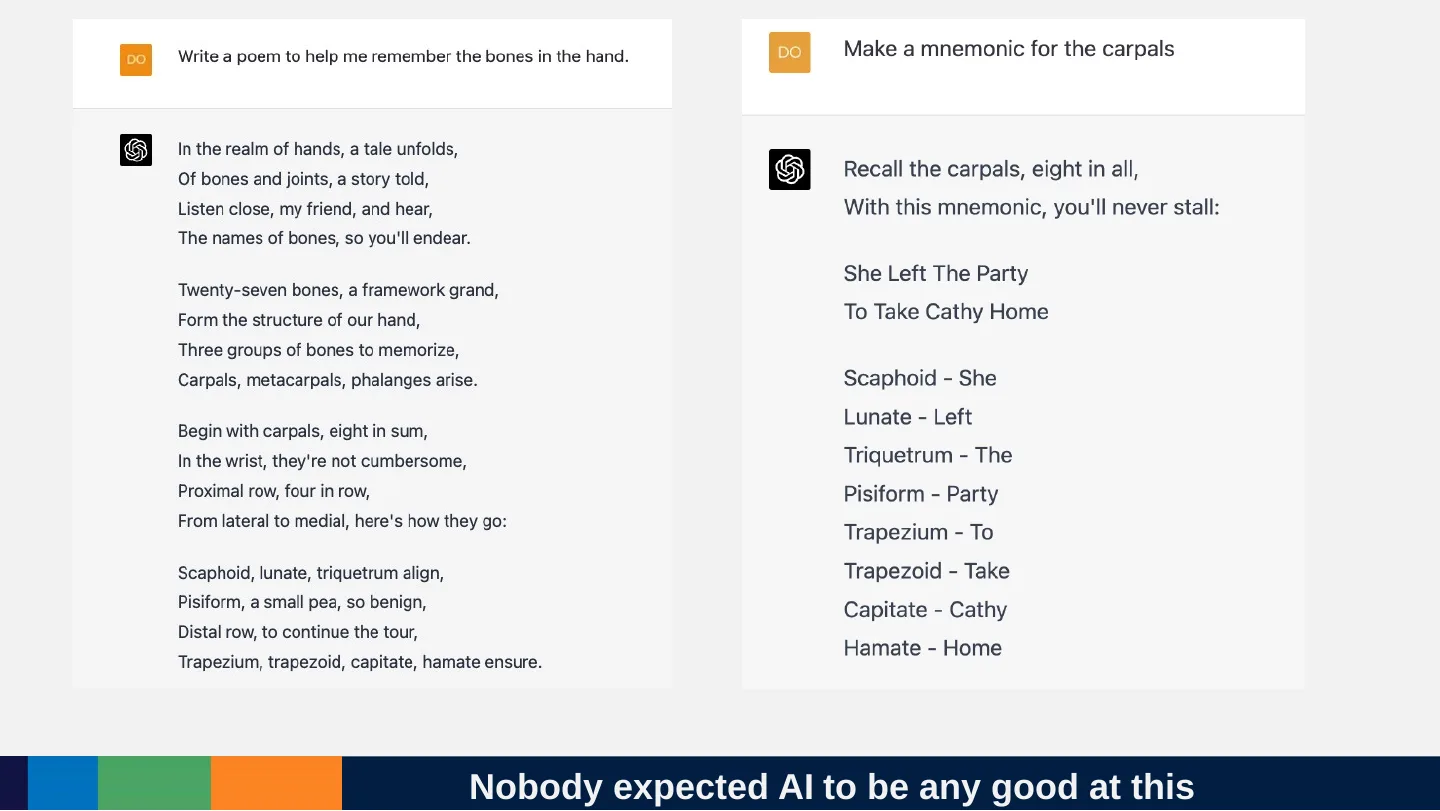
Two ChatGPT conversations side by side. Left: the prompt asks for a poem to remember the bones in the hand and the answer is a four-stanza rhyming poem. Right: the prompt asks for a mnemonic for the carpals and the answer is the sentence “She Left The Party To Take Cathy Home” with each carpal bone matched to a word.

Prompt (left): Write a poem to help me remember the bones in the hand.

In the realm of hands, a tale unfolds,
Of bones and joints, a story told,
Listen close, my friend, and hear,
The names of bones, so you'll endear.

Twenty-seven bones, a framework grand,
Form the structure of our hand,
Three groups of bones to memorize,
Carpals, metacarpals, phalanges arise.

Begin with carpals, eight in sum,
In the wrist, they're not cumbersome,
Proximal row, four in row,
From lateral to medial, here's how they go:

Scaphoid, lunate, triquetrum align,
Pisiform, a small pea, so benign,
Distal row, to continue the tour,
Trapezium, trapezoid, capitate, hamate ensure.

Prompt (right): Make a mnemonic for the carpals

Recall the carpals, eight in all,
With this mnemonic, you'll never stall:

She Left The Party
To Take Cathy Home

  • Scaphoid - She
  • Lunate - Left
  • Triquetrum - The
  • Pisiform - Party
  • Trapezium - To
  • Trapezoid - Take
  • Capitate - Cathy
  • Hamate - Home

View original slide 12

Or this

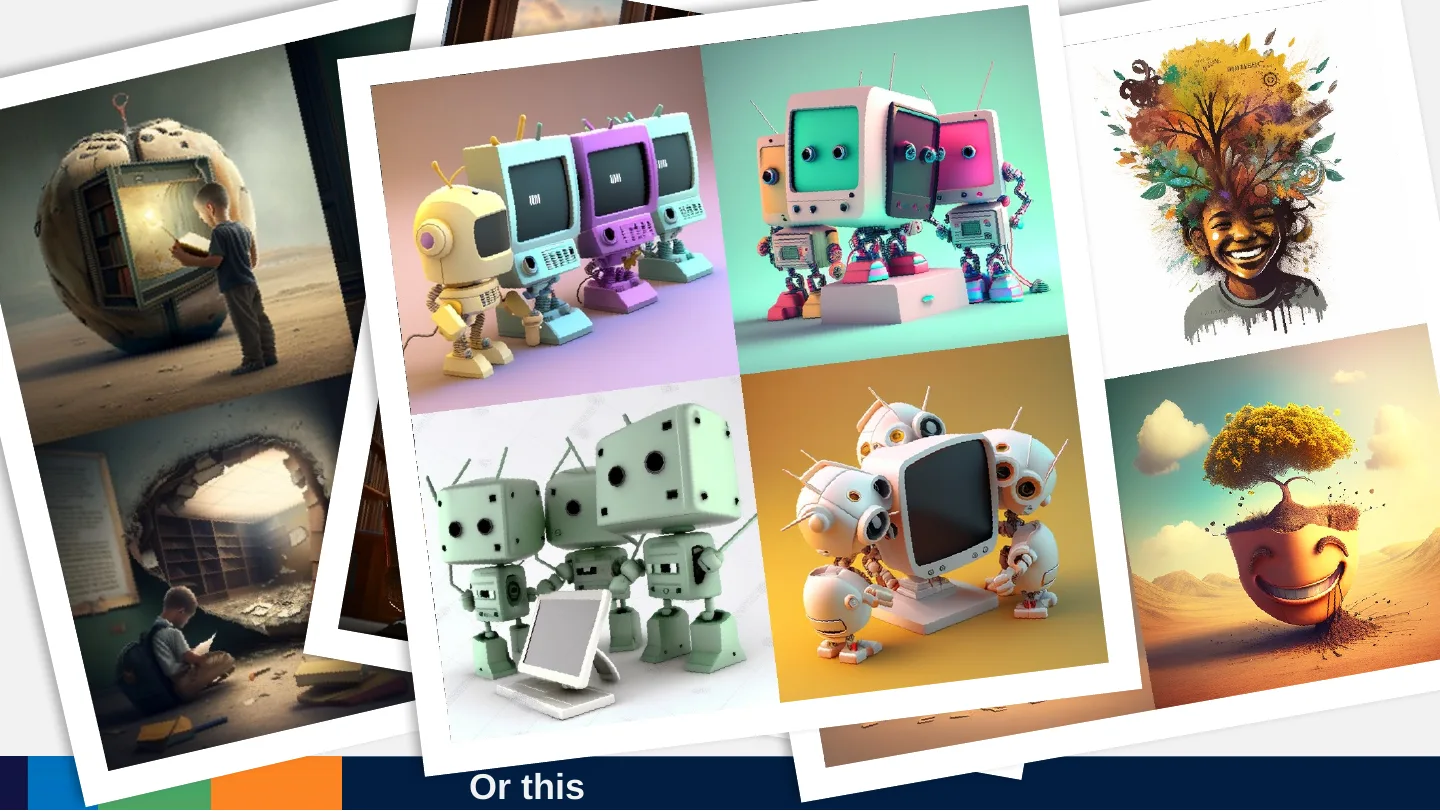
A collage of AI-generated pictures: a man sitting beside a hole in a wall, colourful retro robot and computer characters, a smiling person with a tree of leaves for hair, and a robot reading in a hollow.

View original slide 13

We thought AI could do this

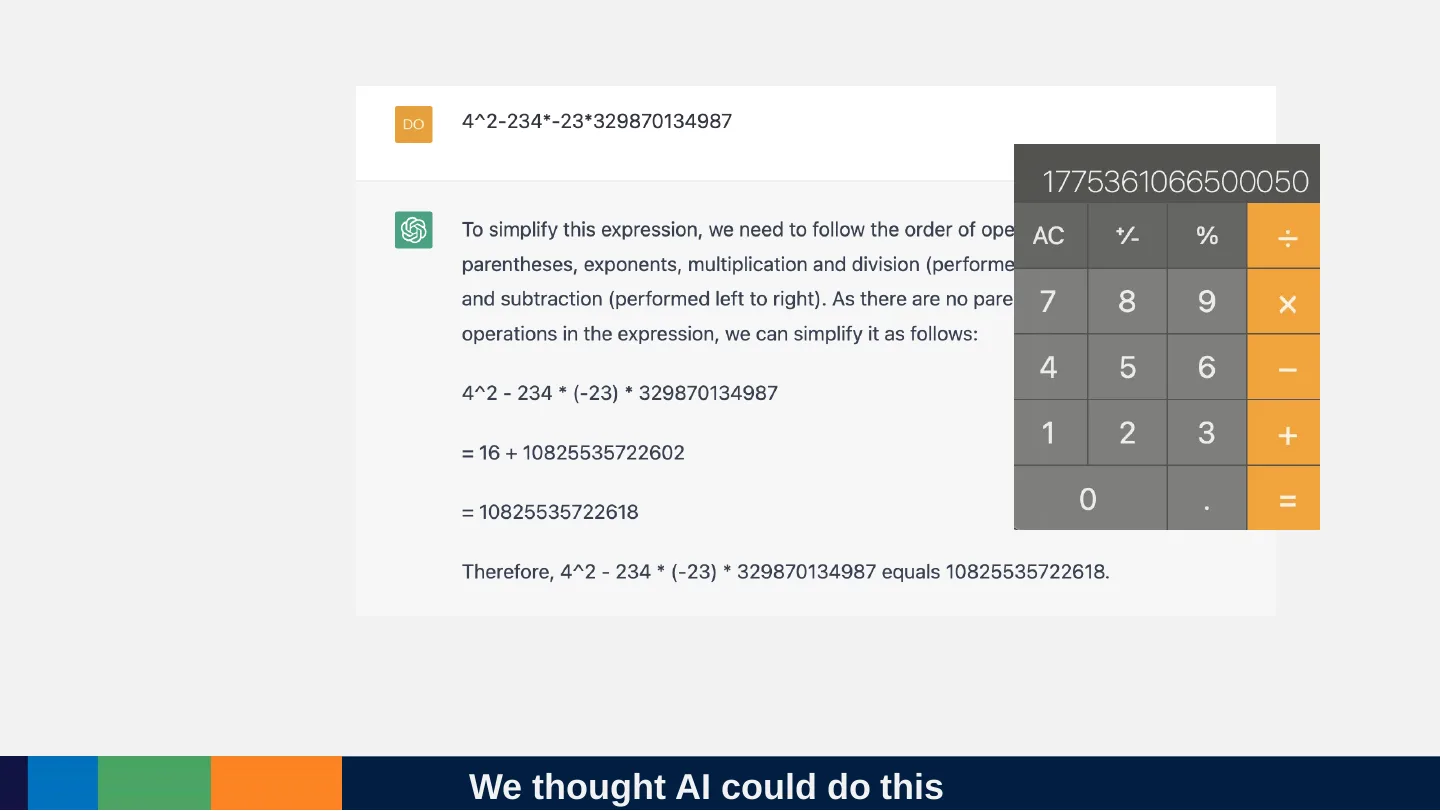
A ChatGPT conversation about the arithmetic “4^2 - 234 * (-23) * 329870134987”: it works through the steps and its answer reads 10825535722618; beside it a calculator shows 1775361066500050.

View original slide 14

But it is also unexpectedly good at this
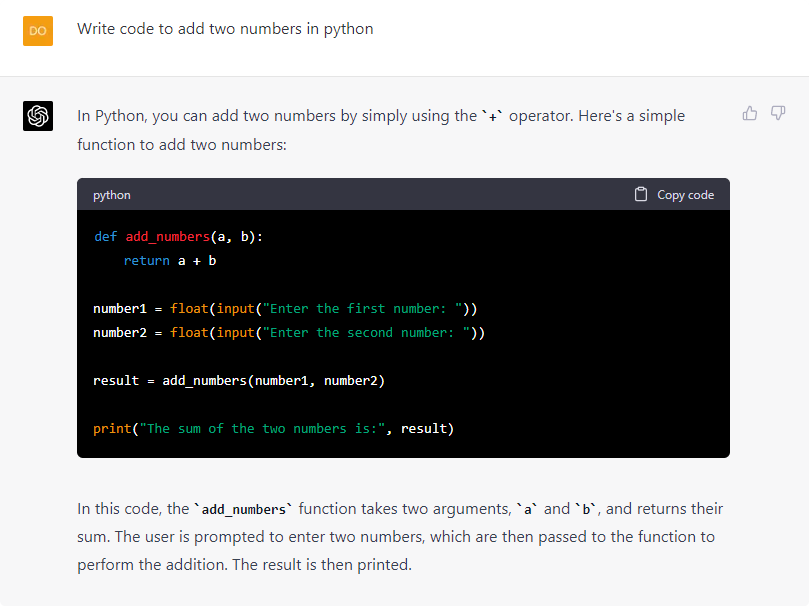
A ChatGPT conversation. The prompt is “Write code to add two numbers in python”. The answer explains the + operator and gives a short Python program with an add_numbers function, followed by an explanation of the code.

Prompt: Write code to add two numbers in python

In Python, you can add two numbers by simply using the + operator. Here's a simple function to add two numbers:

def add_numbers(a, b):

    return a + b

number1 = float(input("Enter the first number: "))

number2 = float(input("Enter the second number: "))

result = add_numbers(number1, number2)

print("The sum of the two numbers is:", result)

In this code, the add_numbers function takes two arguments, a and b, and returns their sum. The user is prompted to enter two numbers, which are then passed to the function to perform the addition. The result is then printed.

View original slide 15

How do we know what modern AI will be good or bad at?

A puzzle-piece icon beside the question.

View original slide 16